Although this can be an intimate and sometimes embarrassing moment, as a human being, it is perfectly natural to and necessary to have a bowel movement !
Optimal digestion means the search for the perfect poo !
Here are several questions you may have asked yourself without ever having dared to ask anyone!

What's in the stool?
Stools are typically composed of water (75%) and a mixture of several heterogeneous substances (25%) ranging from metabolic waste, intestinal bacteria, food debris and undigested fibrous food residues to mucus and bile from the intestine and liver respectively.
What does «healthy bowel movements» mean?
Here are 3 criteria for defining healthy bowel movements.
1. The color
2. The texture
3. Frequency
Criteria 1: Color
The ideal color is, of course, brown.
Why brown?
The brown pigmentation is due to the presence of bile and bilirubin (from the liver), which result from the decomposition of bruised intestinal cells. Note that certain more pigmented foods can alter stool color (e.g. beet and spinach). On the other hand, it's important to know that an abnormal color can also imply a more serious problem.
Why are my stools black?
Cause 1: Certain foods (blueberries and other dark foods) or supplements/drugs (e.g. oral iron supplements, black licorice, bismuth subsalicylate (Pepto-Bismol®)) can turn stools black.
Cause 2 : Black, viscous and very foul-smelling, this could be a sign of internal bleeding in the upper digestive tract. Consult a health care professional.
Why are my stools red?
Cause 1: Certain food colorings and foods such as tomatoes and beet can turn stools red.
Cause 2: The red may be none other than blood. It is important to consult a healthcare professional as soon as possible. The presence of blood in the stool may indicate bleeding in the lower digestive tract, which may be the cause of digestive disease, and should be promptly referred to a health care professional such as; a MII (Inflammatory Bowel Disease), and diverticulitis, polyps, hemorrhoids or colorectal cancer.
Why are my stools green?
Cause 1: Green may be due to iron supplements, green dye or certain green and leafy vegetables.
Cause 2: Too rapid colonic transit (e.g. during SII-diarrhea, flush syndrome) can result in a green coloration in the stool, as the bile moves too quickly to acquire its brownish coloration.
Why are my stools pale yellow or grey?
Cause 1: Yellow color may indicate a liver problem. For example, reduced excretion of biliary stool (contributing to stool browning) may insinuate a problem with the liver and/or gallbladder.
Cause 2: Giardiasis: parasitic infection (Giardia lamblia) causing a variety of gastrointestinal symptoms including vomiting, nausea, bloating, excessive gas, fever and headaches. This parasite can be contracted from a human host, or from contaminated food or water.
In both cases, a healthcare professional should be consulted.
Why are my stools orange?
One of the consequences of an excess of carotenoids (antioxidants found in many orange and leafy vegetables) is stool discoloration.
Why are my stools blue?
Rather rare, but blue discoloration can only be attributed to a high consumption of blue foods (e.g. blueberries, blueberry powder) or blue dye.
Criterion 2: Texture
What is the Bristol scale?
The Bristol Stool Scale is a visual tool for classifying stool according to shape and texture. The scale has 7 grades, with level 1 corresponding to very dry, round stools and level 7 to very liquid, misshapen stools.
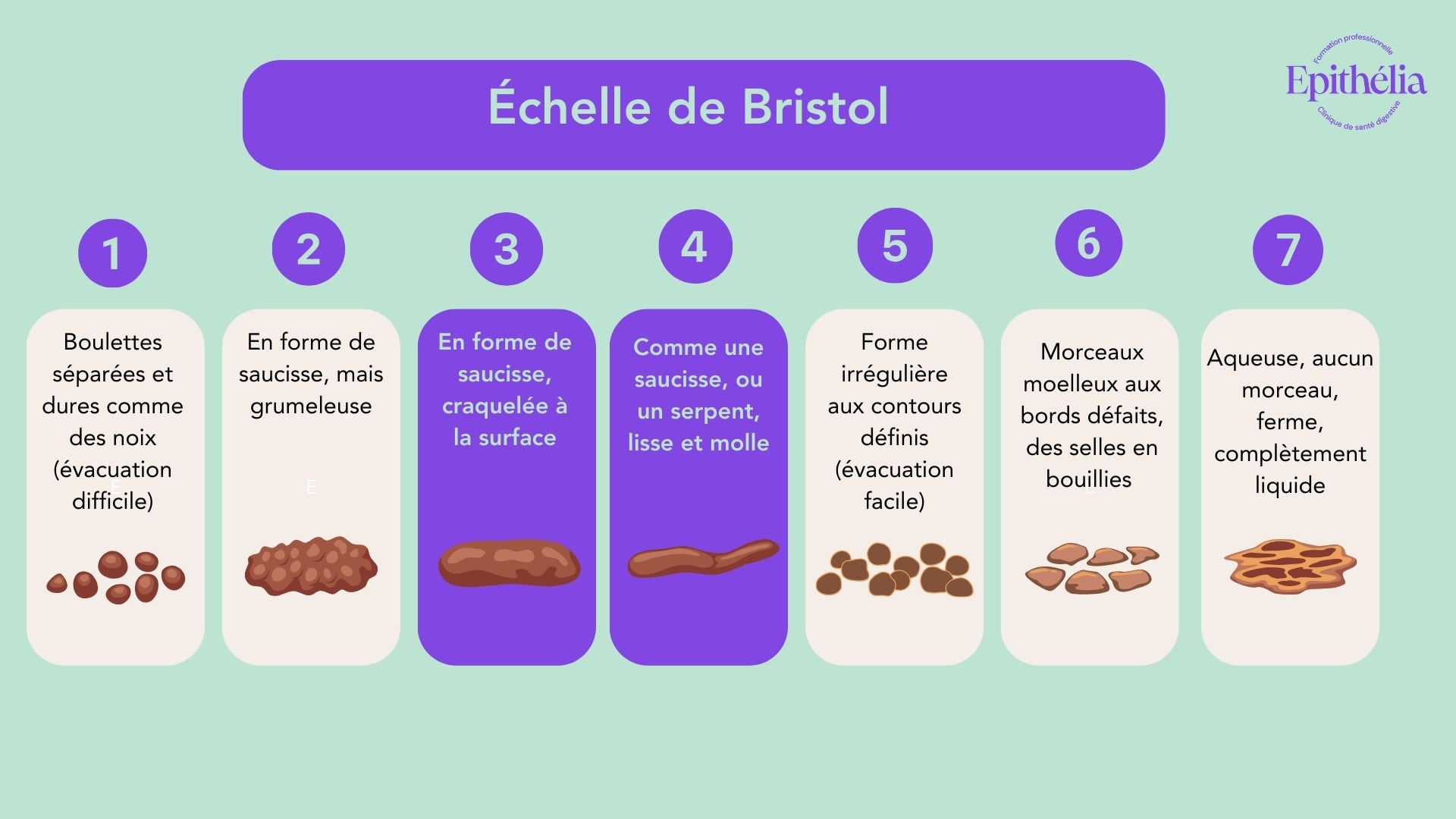
- Levels 1-2 indicate a tendency towards constipation
- Levels 3, 4 and 5 are considered normal.
- Levels 6-7 indicate a tendency towards diarrhoea
Criterion 3: Frequency
The magic number is 3.
In fact, between 3 times a day and 3 times a week is considered normal.
So, the «perfect poo»?
Perfect poop is defined as a brown, long, smooth and soft stool that is excreted effortlessly. The frequency of excretion can range from 1 to 3 times a day to 3 times a week.
Many factors can affect the color, consistency and frequency of bowel movements. These include diet, physical activity, stress, the use of certain medications or supplements, and the presence of an illness.
If in doubt, consult a healthcare professional.
Because we all want optimal digestion resulting in «perfect poo»!
To help you feel good every day, theepithelia's nutritionists have designed a complete training program on digestive health: video capsules, accompanying tools (symptom diary, bonus recipes, fiber calculator) that will enable you to:
- Understand the factors that influence your digestion;
- Understand the potential causes of your digestive symptoms;
- Learn about the different approaches that can help reduce digestive symptoms;
- Get all the tools you need to team up with your body.
- Reduce your digestive symptoms.
- Achieving or even getting closer to the «perfect poop»!

Please note that if you suffer from a particular illness or condition, this training may not meet your needs. Similarly, for those of you who require’individualized support, visit nutritionists from’Epithelia are here for personalized meetings.

References :
- Canadian Society for Intestinal Research. Excreta information: Answers to seven questions. https://badgut.org/centre-information/sujets-de-a-a-z/renseignements-sur-les-excrements/?lang=fr
- Poitras P. et al. The digestive system: From basic science to the clinic (Third revised and expanded edition). (2020). Les Presses de l'Université de Montréal.
 French
  English