
Updated June 2024
For ease of reference, circled figures refer to the reference numbers appended to this document.
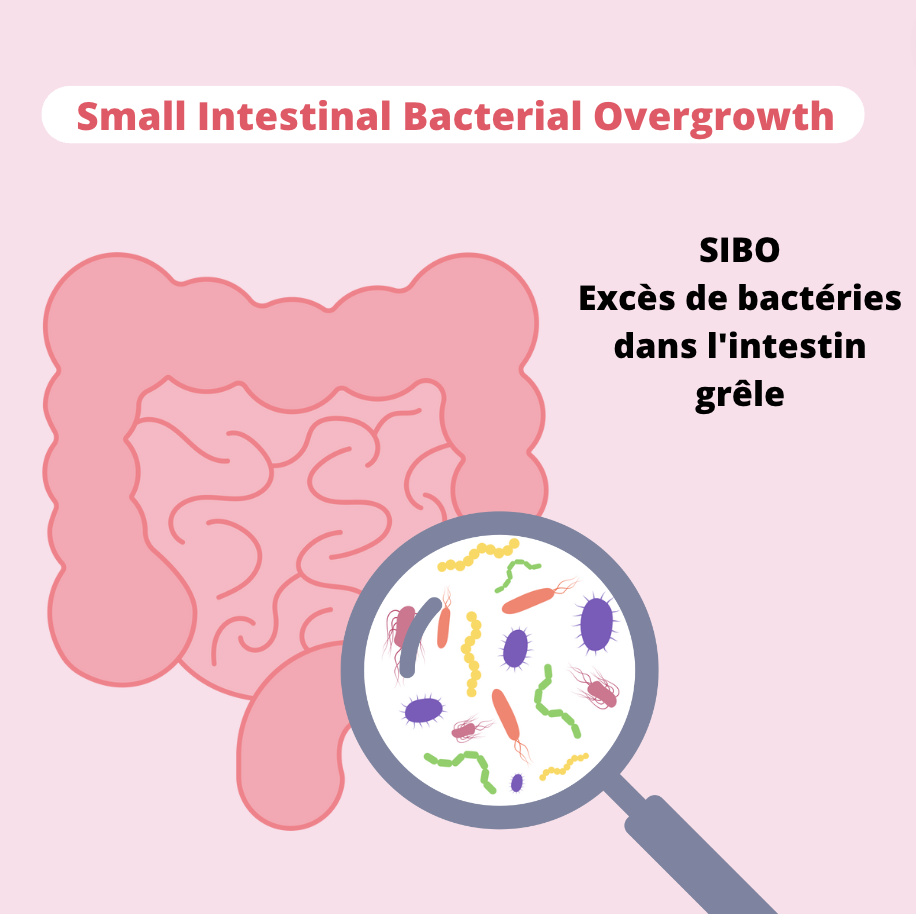
SIBO is the abbreviation for SmallIntestinalBacterialOvergrowth (4). This is a bacterial outbreak in the small intestine that brings with it a series of non-specific symptoms, most of which are digestive in nature. (3)(4)(5). This article will give you a detailed overview of the important information to consider in the context of SIBO.
Simply put, in the context of SIBO, there are too many bacteria in a place in the small intestine that shouldn't contain so many. (4)(5)(11). These bacteria, of the gram-negative proteobacteria type, are capable of producing gases by fermentation, which obviously leads to many symptoms. (3)(4)(5)(7)(8)(10)(11) :
Severe abdominal bloating
Abdominal distension/pain
Intestinal gas, belching
Nausea, vomiting
Diarrhea
Constipation
Fatigue/brain fog
These symptoms resemble those of irritable bowel syndrome (IBS)(4)(7). According to current data, up to 2/3 of people with IBS also suffer from SIBO (4)(10). What these two conditions have in common is a dysbiosis or imbalance of the intestinal microbiota, an increase in intestinal permeability commonly known as leaky gut, and the presence of chronic inflammation (7)(10).
Not only is SIBO difficult to diagnose, it is also laborious to treat (4). What's more, there's a lack of medical consensus on the steps to take (4).
In principle, to diagnose SIBO, fluid is aspirated from the duodenum or jejunum (beginning of the small intestine) and analyzed for bacterial count (3)(4)(8). If its concentration exceeds 103 CFU/ml, a diagnosis of SIBO is made (3)(4). In practice, this measurement is costly, invasive and subject to contamination during sampling (3)(4)(8). With the exception of certain research protocols, access to this test is extremely limited (4).
To date, the Breath test has been used (3)(4). This measures the levels of gases (hydrogen, methane, hydrogen sulfide) exhaled before and after ingestion of glucose or lactulose (3)(4)(8). This test is based on the fact that, apart from CO2, human cells do not produce methane, hydrogen or hydrogen sulfide (3). These are produced by bacteria (or archaea, in the case of methane) as a result of fermentation (3)(4). Consequently, the more of these gases exhaled through the mouth following ingestion of these sugars, the more likely it is that there is bacterial overgrowth in the small intestine (4). The test is therefore simple, safe and non-invasive (3)(4).
Unfortunately, to date, respiratory tests are unreliable, i.e. their sensitivity and specificity are low (4)(11). As a result, there are often «false positives», i.e. SIBO that would be identified without this actually being the case (4). It should be noted, however, that this remains the only test available to date, and is proposed in the guidelines of certain medical associations, including the American College of Gastroenterology (4). Clinical experience thus becomes an essential asset in helping people suffering from this problem, guiding them towards the right option and the right professionals to support them in their approach.
Older age and female gender
Autoimmune or immune-mediated diseases: e.g. diabetes, untreated celiac disease, inflammatory bowel disease (IBD), hypothyroidism, multiple sclerosis, fibromyalgia
Partial or intermittent obstruction of the small intestine, surgical alterations to the gastrointestinal tract: e.g. bariatric surgery
Low gastric acidity: e.g. proton pump inhibitors (PPIs), advanced age, regular use of antacids
Intestinal motor disorders: IBS, gastroparesis, functional dyspepsia;
Nerve or intestinal muscle dysfunction
Taking certain medications: opioids, antidiarrheals, anticholinergics
Diverticula of the small intestine, stenosis, fistula
With regard to the latter, it is recognized that gastric acidity plays an important role in preventing bacterial overgrowth in the upper digestive tract (4).
Have Pantoloc/Dexilant/Nexium/Prevacid/Losec proton pump inhibitors (PPIs) been part of your life for many years? One study has shown that you are 3 times more likely to develop SIBO (4)(6). Other studies have observed that the prevalence of SIBO was more than 50% for patients taking PPIs (11). The severity of symptoms seems to increase with prolonged use (11), but it is not yet possible to determine the dose, duration and type of exposure that affect this risk (4)(6).
Without being an integral part of the SIBO diagnostic approach, here are a few elements that may prompt the clinician to question his or her approach or investigation (4)(5).
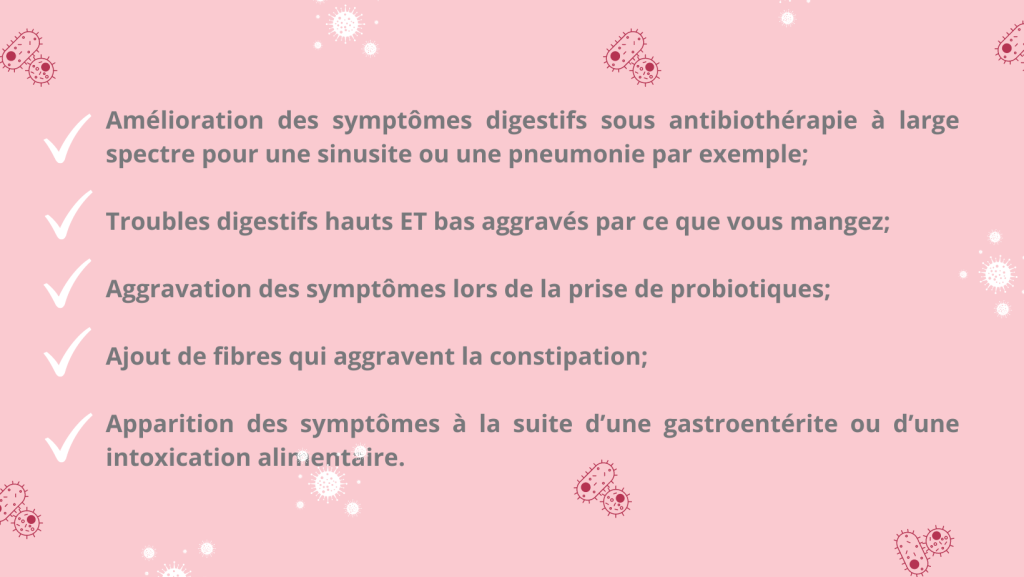
Phrases such as «I swell up after a glass of water» or «I look 5 months pregnant at night» are regularly heard in the context of SIBO. Again, none of this leads to a diagnosis, but it can put you on the right track.
Once SIBO has been identified and diagnosed, what do we do?
Ideally, it should be treated. The doctor may prescribe an antibiotic for 14 days, to stop bacterial proliferation. (4). The type of antibiotic will vary according to the type of SIBO (hydrogen or methane) and the patient's symptomatology. (4). Recurrences are unfortunately very frequent (44% within 9 months of antibiotic therapy), especially if the real cause of SIBO has not been identified. (6). This is a symptom of another problem that needs to be identified. (4).
Once again, interdisciplinary work is essential.
What is the role of nutrition in the treatment of SIBO (9)?
- Symptom management;
- Maintaining a healthy relationship with food;
- Meet nutritional needs;
- Correct nutritional deficiencies where necessary.
Nutrition can also increase the durability of antibiotic treatment to help prevent recurrence (9).
As the field is relatively new in terms of evidence, there is no specific diet that has been scientifically validated to treat or prevent SIBO (2).(4)(8).
You'll read or hear words like Low-fermentation diet, Specific carbohydrate diet, Biphasic diet or SIBO specific food guide, However, all these diets are based on patient clinical experience and have not yet been the subject of studies. (4)(5)(8)(9). Does this discredit them? That depends. The problem is often that these diets are very restrictive (9). As a result, we eat almost nothing, and our relationship with food becomes unhealthy. The fear of eating and of reacting is also very present (9). Food variety gradually diminishes and we fall into a vicious circle, becoming even more reactive to everything we eat (9). The best thing to do, of course, is to be accompanied by an experienced nutritionist, working in close collaboration with doctors and gastroenterologists in this personalized follow-up.
The majority of nutritional interventions come from those carried out in the context of irritable bowel syndrome, which consist in limiting fermentable carbohydrates/FODMAPs and finding the right families of fibers that suit your comfort. (1)(2)(4)(7)(9). We want to «starve» the excess bacteria while making sure not to harm the overall quality of your gut microbiota (9).
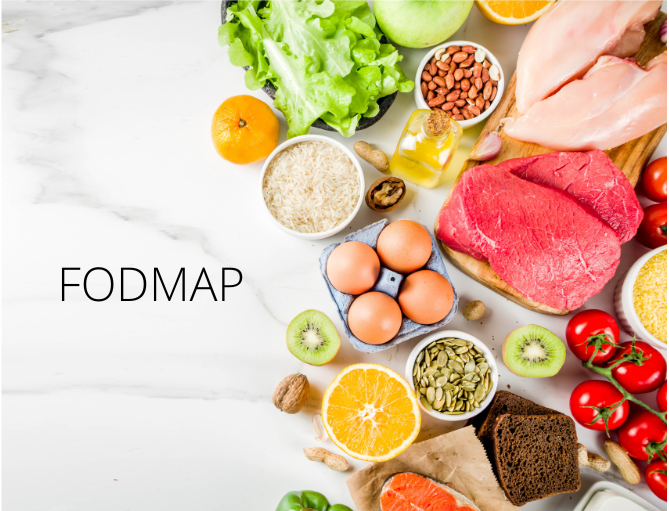
A nutritionist team can help you establish the best game plan for you: quantity and quality of carbohydrates, optimal spacing between meals, hydration, validation of other food intolerances or sensitivities, trial of a probiotic, use of dietary supplements if necessary and other approaches. (2)(4)(5)(8). She can also guide you through the process with your GP or specialist, if required.
Don't hesitate to write for more details
A training medical literature on the subject is also available; don't hesitate to ask!
References
(1) FODMAPs and Irritable Bowel Syndrome (2019) Monash University https://www.monashfodmap.com/about-fodmap-and-ibs/
(2) Knez E, Kadac-Czapska K, Grembecka M. The importance of food quality, gut motility, and microbiome in SIBO development and treatment. Nutrition. 2024 Apr 5;124:112464. https://pubmed.ncbi.nlm.nih.gov/38657418/
(3) Lim J, Rezaie A. Pros and Cons of Breath Testing for Small Intestinal Bacterial Overgrowth and Intestinal Methanogen Overgrowth. Gastroenterol Hepatol (NY). 2023 Mar;19( 3 ):140-146. https://pubmed.ncbi.nlm.nih.gov/37706108/
(4) Pimentel M, Saad RJ, Long MD, Rao SSC. ACG Clinical Guideline: Small Intestinal Bacterial Overgrowth. Am J Gastroenterol. 2020 Feb;115( 2 ):165-178. https://pubmed.ncbi.nlm.nih.gov/32023228/
(5) Pimentel M, Rezaie A. (2022) The microbiome connection Your guide to IBS, SIBO and low-fermentation eating.
(6) Rao SSC, Bhagatwala J. Small Intestinal Bacterial Overgrowth: Clinical Features and Therapeutic Management. Clin Transl Gastroenterol. 2019 Oct;10(10):e00078. https://pubmed.ncbi.nlm.nih.gov/31584459/
(7) Redondo-Cuevas L, Belloch L, Martín-Carbonell V, Nicolás A et al. Do Herbal Supplements and Probiotics Complement Antibiotics and Diet in the Management of SIBO? A Randomized Clinical Trial. Nutrients. 2024 Apr 7;16( 7 ):1083. https://pubmed.ncbi.nlm.nih.gov/38613116/
(8) Scarlata K. (2022) Small Intestinal Bacterial Overgrowth Update + Overview: Treatments, Testing and Current Approaches to Managing Symptoms.
(9) Scarlata K. (2021) SIBO: Practical nutrition intervention and clinical pearls. Dietitian Depp Dive.
(10) Scarlata K. (2021) SIBO Primer: What it is + How to treat and SIBO: Practical nutrition intervention and clinical pearls. Dietitian Depp Dive.
(11) Zafar H, Jimenez B, Schneider A. Small intestinal bacterial overgrowth: current update. Curr Opin Gastroenterol. 2023 Nov 1;39( 6 ):522-528. https://pubmed.ncbi.nlm.nih.gov/37751393/
 French
  English