Coconut, and particularly its oil, has been popular in recent years. But is this oil a good choice?
Composition of coconut oil
To establish whether an oil has a more «interesting» impact on health, it's important to know and understand its composition in terms of fat types (2). Saturated fats and trans are considered «less good» fats for cardiovascular health. Conversely, monounsaturated and polyunsaturated fats are associated with overall health and cardiovascular benefits.
For this reason, coconut oil is very high in saturated fats (4). This type of fat makes up over 90% (1, 3). This is why coconut oil is as solid at room temperature as butter, which is also rich in saturated fats.
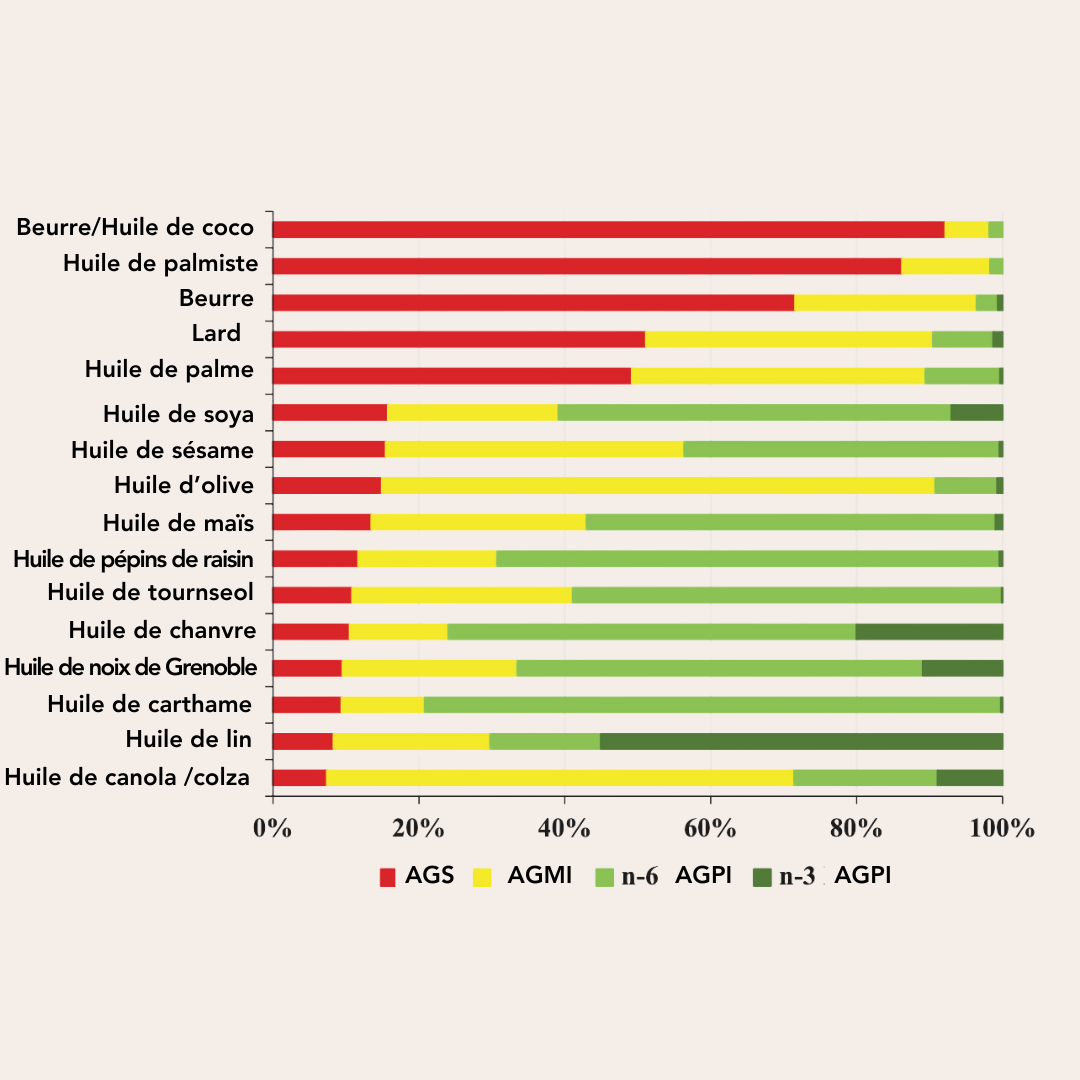
Figure of compositional differences between various fats and oils Adapted from Feingold (2024) (1)
Coconut oil and cardiovascular health
Impact on lipid (fat) markers
In several studies, oils rich in monounsaturated and polyunsaturated fats, such as canola oil and virgin olive oil, have been shown to reduce total and LDL (often referred to as «bad») cholesterol (1, 4). Oils rich in saturated fats, such as coconut and palm oil, on the other hand, have been shown to increase total and LDL cholesterol (1, 4). On the other hand, oils rich in saturated fats appear to slightly increase HDL cholesterol (often referred to as «good» cholesterol) (1, 3, 4). However, this observation on HDL cholesterol requires further study (3).
What are we comparing it to?
The impacts of coconut oil on their lipid markers obviously differ depending on the oils compared. Indeed, according to a 2019 meta-analysis, coconut oil can increase LDL cholesterol when compared to other vegetable oils (2). On the other hand, coconut oil can reduce LDL cholesterol when compared to other animal fats rich in saturated fat, such as butter, beef fat and lard (2).


Potential benefits of coconut oil
Some studies show potential effects antioxidants of coconut oil and reducing oxidative stress (3). However, further studies are needed to support this (3).
So, is coconut oil good or bad?
In moderation
In short, coconut oil can continue to be consumed in moderation for its unique taste, which is appreciated by many. If you love butter, substituting it with coconut oil may not be a bad idea for your lipid markers!
On the other hand, every day, it's better to opt for oils rich in unsaturated fats, such as olive, avocado, canola or camelina oil, which have more proven health benefits (2)! Mediterranean diet is still the preferred choice. Reducing saturated fats and increasing unsaturated fats is still true (2)!
Receipts:

- Feingold (2024) The Effect of Diet on Cardiovascular Disease and Lipid and Lipoprotein Levels.Mar 31 Endotext [Internet]. South Dartmouth (MA): MDText.com, Inc; 2000-. PMID: 33945244. https://pubmed.ncbi.nlm.nih.gov/33945244/
- Rosqvist and Niinistö (2024) Fats and oils - a scoping review for Nordic Nutrition Recommendations 2023. Food Nutr Res. Feb 9;68. https://pubmed.ncbi.nlm.nih.gov/38370114/
- Sekhar et al (2022) Are We Nuts Over Coconuts? Studying the Effects of Coconut Oil on Low-Density Lipoprotein and Cardiovascular Diseases: A Systematic Review. 2022 Apr 17;14(4):e24212. https://pubmed.ncbi.nlm.nih.gov/35637823/
- Voon et al (2024) Health effects of various edible vegetable oils: An umbrella review. Adv Nutr. Jul 23:100276. https://pubmed.ncbi.nlm.nih.gov/39053603/
 French
  English