
Our mental health: is it feeding can influencer?
If you think about it, the contents of your plate could affect your mental health!
Did you know that many aspects of your eating habits can have a significant impact on your stress level, your mood, your level of irritability and even your risk of depression??
Here are the eating habits that can have a significant impact on your mental health.
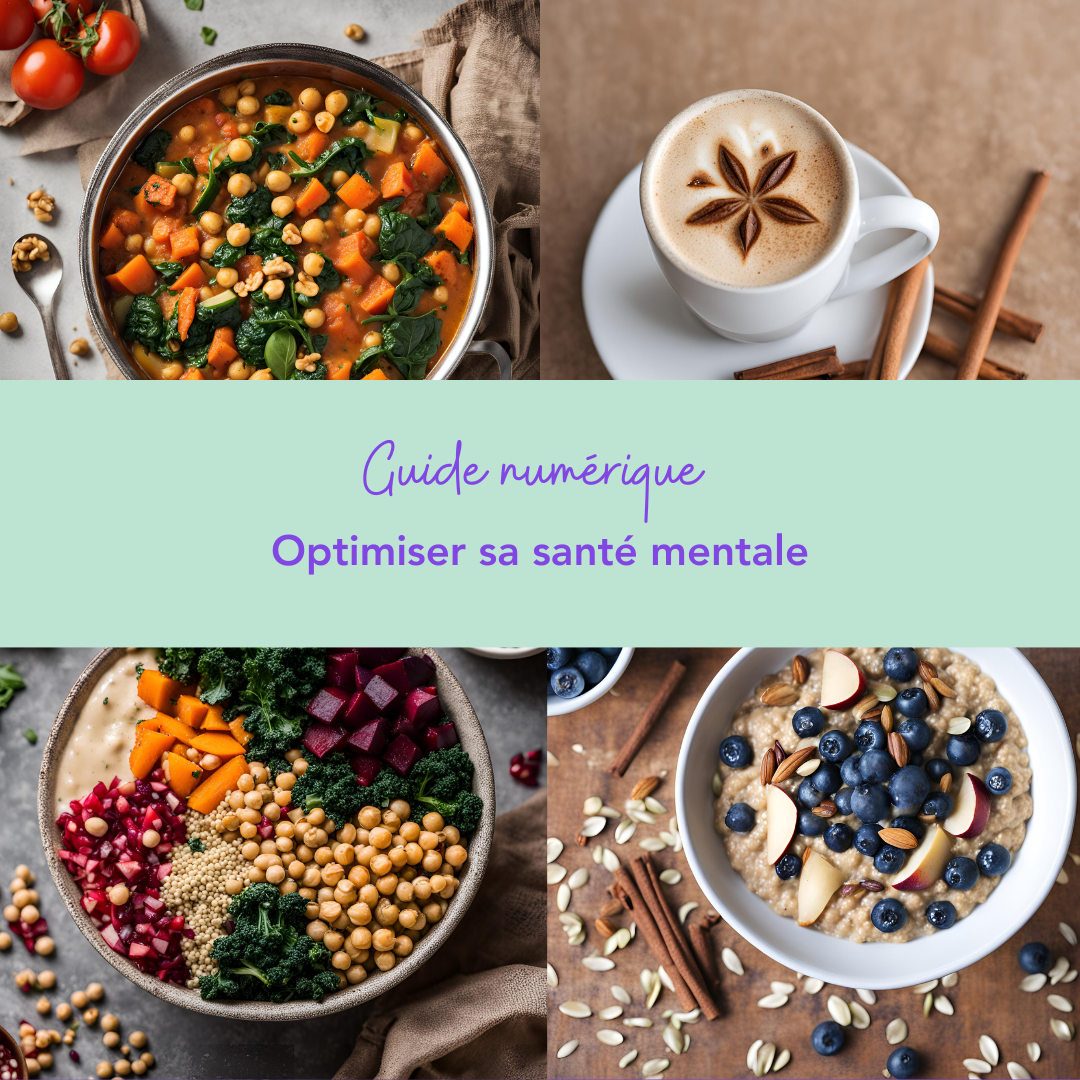
Good fats!
First and foremost, avoid diets that restrict fat too much (fats). Indeed, some studies have shown an association between very low-fat diets and an increased risk of mood disturbances (irritability/stress), sleep problems and even depression (1-2).
What's more, this restriction ons grasses could also lead to hormonal imbalances and deficiencies in certain vitamins. liposoluble (absorbed with fats) including vitamin A, D, E and K (3).
Try to choose the right sources of unsaturated fats (mainly omega-3 monounsaturates and polyunsaturates) on your menu.
A quick reminder about the sources of these famous «good» fats:
- Olive oil, canola oil, avocado oil, flax, hemp;
- Nuts and butters nut;
- Seeds (flax, chia, hemp), camelina, sunflower and pumpkin);
- Pink-fleshed fish (sardines, mackerel, salmon, trout), herring, tuna);
- Avocado, olives
Omega-6 / omega-3 ratio
In Western populations, the diet is very rich in omega-6 and, conversely, quite low in omega-3. This creates a much higher omega-6/omega-3 ratio than is desirable. To reduce this effect, we recommend optimizing omega-3 intake, while reducing omega-6 intake.
Due to their presence in some of the oils mentioned below, omega-6s are particularly present in processed products. In this sense, cooking food at home is one of the priority recommendations.
| Source of omega-3 | Source of omega-6 |
| Oily fish (salmon, trout, mackerel, tuna, sardines, mackerel, herring) Cold-pressed camelina or canola oil Chia, flax or camelina seeds |
Corn, safflower, soybean, sunflower oil Meat, poultry, fish, eggs |

Mediterranean diet
Try to get as close as possible to the Mediterranean diet. Although this is based on observational studies, following the principles of the Mediterranean diet would be associated with ae risk reduction up to 33% (4)!
In addition to its potential effects on mental health, here are the other benefits of’apply the principles of the Mediterranean diet (5-12):
- Reduced risk of cardiovascular diseases;
- Lower blood pressure;
- Reduced inflammation;
- Reduced risk of type 2 diabetes;
- Reduced risk of certain types of cancer;
- Reduced cognitive decline;
- Improved longevity.
- This model is based on the ancestral traditions of the people who lived around the Mediterranean Sea (Greece), sud the’Italy).
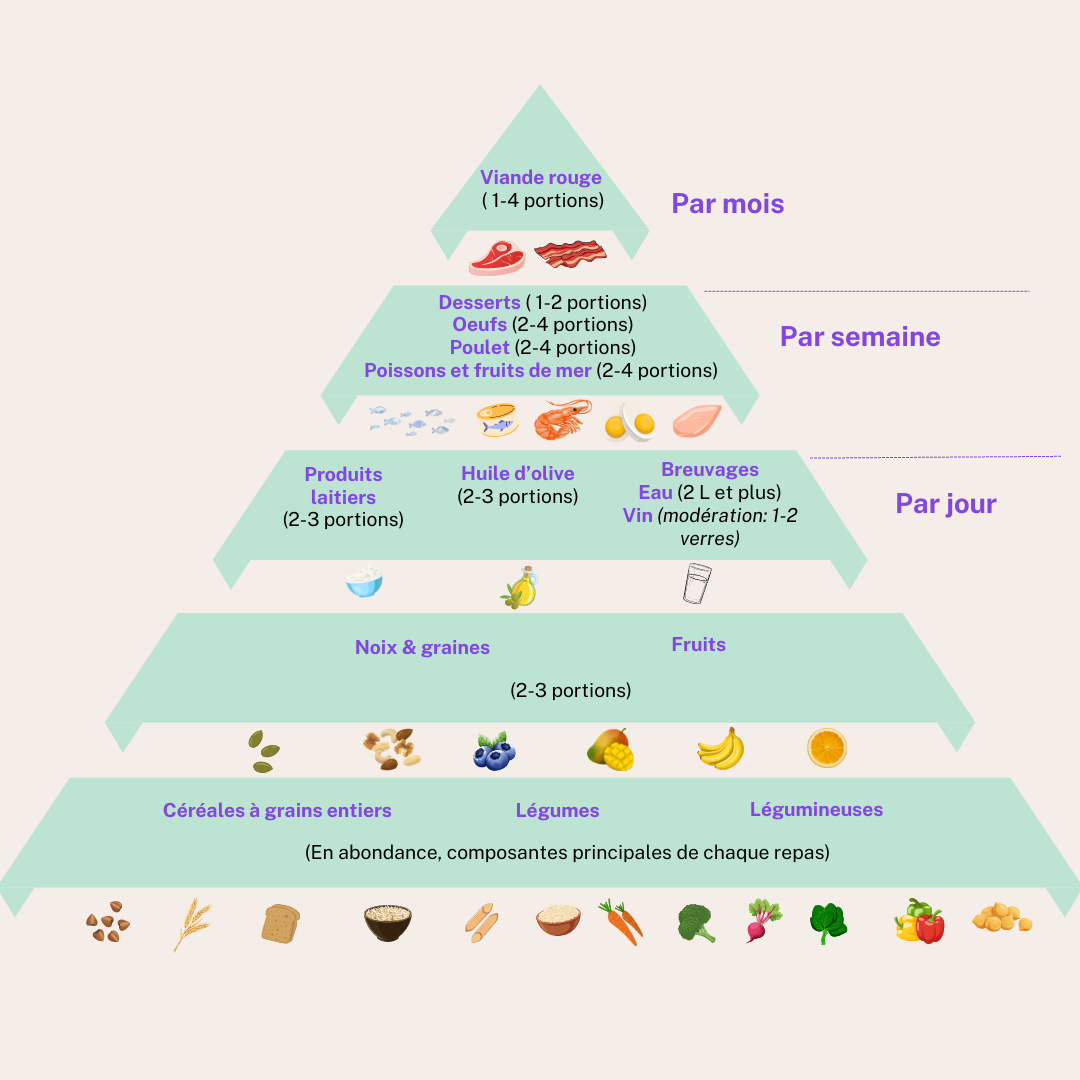
On the menu: lots of olive oil, plant foods (legumes, whole grains, vegetables, fruit, nuts and seeds), moderate amounts of fish, poultry and low-fat dairy products. and limited meat consumptions reds, delicatessens and sweets. And the occasional glass of red wine!
Here's the Mediterranean diet pyramid
Impact of weight on depression
Last but not least, the’two-way association between obesity and depression. Depression increases the risk of obesity, and obesity in turn increases the risk of depression - a veritable vicious circle (13-14).
Scientific studies are quite clear. A successful weight loss and weight management in people with obesity are associated with improved mental health and quality of life (15). The subject of weight loss is a very delicate one, due to its multifactorial aspects. Enlist the support of healthcare professionals, including a nutritionist, in your approach.

And what about the microbiota?
Did you know that the enteric nervous system surrounding the he digestive system is made up of several hundred million neurons. This is what is commonly referred to as the digestive system, the «second brain».
Not only does he have a relationship with the immune system and the microbiota, but he talks constantly with the central nervous system, the «the »first and true" brain. This communication highway is part of the normal functioning of l’organization.
However, a growing body of research shows that is possible d’The communication channels between the two could be disrupted, and this disruption could, for example, change the way the two are connected, the stress response. Part of this communication is assumed by the microbiota, an ecosystem comprising billions of bacteria.
Although more studies are needed to confirm this, take care of your microbiota by «nourishing» it» seems to be an interesting avenue for mental health and with few risks or side effects (16).
Conclusion
In general, remember that a healthy diet will certainly help you enjoy better energy on a daily basis, while maximizing your mental state.
Interested in this subject? Did you know that we give conferences on the subject and much more surrounding nutrition and digestive health?

References
- Kamau C. A low fat diet can make you angry, irritable and depressed. Why dietary fat contributes to good mental health. https://www.psychologytoday.com/ca/blog/thescience-mental-health/202002/low-fat-diet-can-make-you-angry-irritable-and-depressed
- Le Port A, Gueguen A, Kesse-Guyot E, Melchior M, Lemogne C, Nabi H, Goldberg M, Zins M, Czernichow S. Association between dietary patterns and depressive symptoms over time: a 10-year follow-up study of the GAZEL cohort. PLoS One. 2012;7(12):e51593 https://pubmed.ncbi.nlm.nih.gov/23251585/
- Schilling LP. Disorder in disguise recognizing the need for change when common diet trends cause harm. ACSM's Health & Fitness Journal. 2018 Sept; 22(5): 34-39. https://journals.lww.com/acsm-healthfitness/fulltext/2018/09000/disorder_in_disguise__recognizing_the_need_for.10.aspx
- Madani S, Ahmadi A, Shoaei-Jouneghani F, Moazen M, Sasani N. The relationship between the Mediterranean diet and Axis I disorders: A systematic review of observational studies. Food Sci Nutr. 2022 Jun 6;10(10):3241-3258. https://pubmed.ncbi.nlm.nih.gov/36249971/
- Cowell OR, Mistry N, Deighton K, Matu J, Griffiths A, Minihane AM, Mathers JC, Shannon OM, Siervo M. Effects of a Mediterranean diet on blood pressure: a systematic review and meta-analysis of randomized controlled trials and observational studies. J Hypertens. 2021 Apr 1;39(4):729-739. https://pubmed.ncbi.nlm.nih.gov/33060448/
- Filippou CD, Thomopoulos CG, Kouremeti MM, Sotiropoulou LI, Nihoyannopoulos PI, Tousoulis DM, Tsioufis CP. Mediterranean diet and blood pressure reduction in adults with and without hypertension: A systematic review and meta-analysis of randomized controlled trials. Clin Nutr. 2021 May;40(5):3191-3200. https://pubmed.ncbi.nlm.nih.gov/33581952/
- Shannon OM, Mendes I, Köchl C, Mazidi M, Ashor AW, Rubele S, Minihane AM, Mathers JC, Siervo M. Mediterranean Diet Increases Endothelial Function in Adults: A Systematic Review and Meta-Analysis of Randomized Controlled Trials. J Nutr. 2020 May 1;150(5):1151-1159. https://pubmed.ncbi.nlm.nih.gov/32027740/
- Fatima K, Rashid AM, Memon UAA, Fatima SS, Javaid SS, Shahid O, Zehri F, Obaid MA, Ahmad M, Almas T, Minhas AMK. Mediterranean Diet and its Effect on Endothelial Function: A Meta-analysis and Systematic Review. Ir J Med Sci. 2023 Feb;192(1):105-113. https://pubmed.ncbi.nlm.nih.gov/35192097/
- Becerra-Tomás N, Blanco Mejía S, Viguiliouk E, Khan T, Kendall CWC, Kahleova H, Rahelić D, Sievenpiper JL, Salas-Salvadó J. Mediterranean diet, cardiovascular disease and mortality in diabetes: A systematic review and meta-analysis of prospective cohort studies and randomized clinical trials. Crit Rev Food Sci Nutr. 2020;60(7):1207-1227. https://pubmed.ncbi.nlm.nih.gov/30676058/
- Soltani S, Jayedi A, Shab-Bidar S, Becerra-Tomás N, Salas-Salvadó J. Adherence to the Mediterranean Diet in Relation to All-Cause Mortality: A Systematic Review and Dose-Response Meta-Analysis of Prospective Cohort Studies. Adv Nutr. 2019 Nov 1;10(6):1029-1039. https://pubmed.ncbi.nlm.nih.gov/31111871/
- Canudas S, Becerra-Tomás N, Hernández-Alonso P, Galié S, Leung C, Crous-Bou M, De Vivo I, Gao Y, Gu Y, Meinilä J, Milte C, García-Calzón S, Marti A, Boccardi V, Ventura-Marra M, Salas-Salvadó J. Mediterranean Diet and Telomere Length: A Systematic Review and Meta-Analysis. Adv Nutr. 2020 Nov 16;11(6):1544-1554. https://pubmed.ncbi.nlm.nih.gov/32730558/
- Dinu M, Pagliai G, Casini A, Sofi F. Mediterranean diet and multiple health outcomes: an umbrella review of meta-analyses of observational studies and randomised trials. Eur J Clin Nutr. 2018 Jan;72(1):30-43. https://pubmed.ncbi.nlm.nih.gov/28488692/
- Milaneschi Y, Simmons WK, van Rossum EFC, Penninx BW. Depression and obesity: evidence of shared biological mechanisms. Mol Psychiatry. 2019 Jan;24(1):18-33. https://pubmed.ncbi.nlm.nih.gov/29453413/
- Preiss K, Brennan L, Clarke D. A systematic review of variables associated with the relationship between obesity and depression. Obes Rev. 2013 Nov;14(11):906-18. https://pubmed.ncbi.nlm.nih.gov/23809142/
- Pedersen S, Manjoo P, Wharton S. Canadian Adult Obesity Clinical Practice Guidelines: Pharmacotherapy for obesity management. Obesity Canada; 2022. Online: https://obesitycanada.ca/wp-content/uploads/2022/10/ Pharmacotherapy-CPG-2022_final.pdf
- Jackson PP, Wijeyesekera A, Williams CM, Theis S, van Harsselaar J, Rastall RA. Inulin-type fructans and 2’fucosyllactose alter both microbial composition and appear to alleviate stress-induced mood state in a working population compared to placebo (maltodextrin): the EFFICAD Trial, a randomized, controlled trial. Am J Clin Nutr. 2023 Nov;118(5):938-955. https://pubmed.ncbi.nlm.nih.gov/37657523/
 French
  English