Updated May 2024
For ease of reference, circled figures refer to the reference numbers appended to this document.
You know how important the microbiota is to overall health. But did you know that it is also associated with the health of your skin?
In fact, several studies have reported a dysbiosisThis is an alteration in the composition, quality and quantity of intestinal bacteria in certain inflammatory dermatological diseases (3)(9)(10)(14)(18). This is the case for acne, psoriasis, atopic eczema and rosacea (3)(7)(10)(11)(14)(18)(19).
For example, in acne sufferers, studies show a reduction in intestinal bacterial diversity and a lower ratio of Firmicutes/Bacteroideteswhich can contribute to an increase in intestinal permeability (3)(19).
In scientific studies on the subject, authors often use the term intestine-skin axis (3)(10)! This represents the two-way relationship between intestine and skin (3)(11)(19).
In fact, these two organs share several common features (3):
- Essential for immune function;
- Highly sensitive to stress and anxiety;
- Home to many bacterial, fungal and viral species.
Here are a few examples of potential interactions between the gut and the skin:
- It is estimated that between 7 and 11% of people with a irritable bowel syndrome (SII) have psoriasis (3). Both pathologies have inflammatory components, and an altered microbiota is present in both cases (3)! For more details on irritable bowel syndrome (IBS), see this article.
- In people with rosacea, the prevalence of Small Intestinal Bacterial Overgrowth (SIBO) is superior, and removal of SIBO significantly reduces skin lesions (3) (see article SIBO, not so pretty! for more details). This demonstrates the potential link between these two conditions (3).
A disturbance in their microbial balance, i.e. the presence of dysbiosis in the skin or intestine, leads to an alteration in the function of their respective barriers (3)(7)(11)(14). This dysfunction promotes the synthesis of inflammatory molecules which, whether produced in the inner layers of the skin or the intestinal mucosa, can enter the bloodstream and cause a great deal of damage along the way (3)(11)(14). These inflammatory molecules can also affect the barrier quality of both, meaning that a disturbance in the skin, via the inflammatory molecules produced, can induce a disturbance in the intestinal barrier (3)(11). These chain reactions clearly demonstrate the intestine-skin link and their impact on each other (3)(11)!
This image illustrates the possible associations of two organs in a context of equilibrium (eubiose) and disturbance (dysbiosis) of the microbiota (11) :
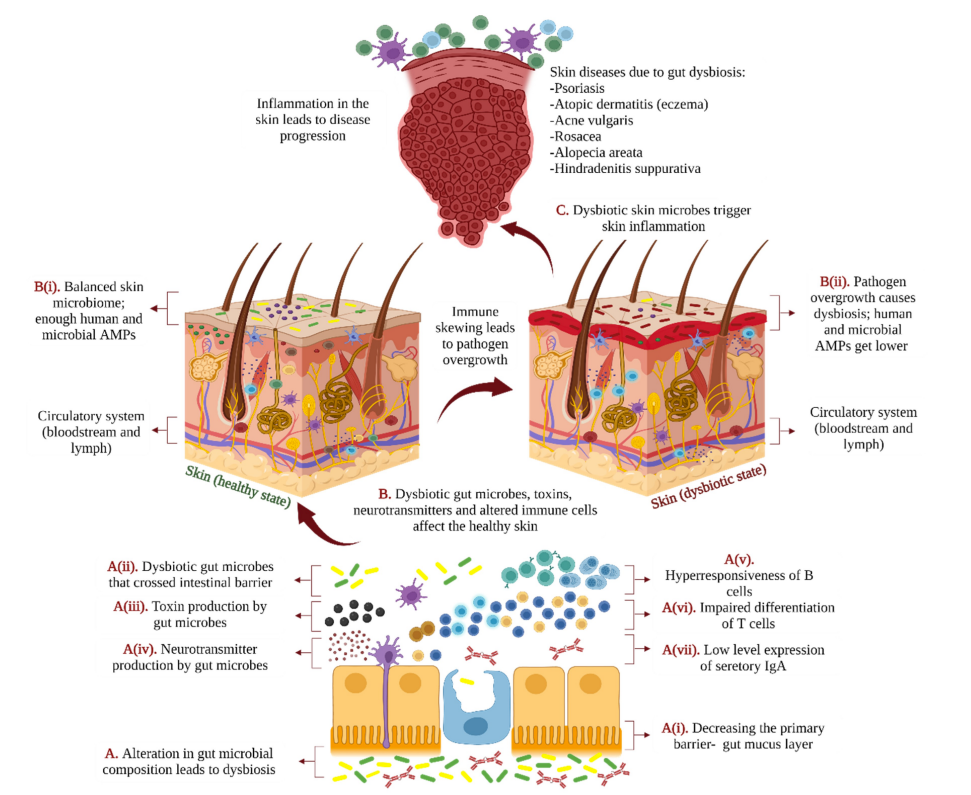
From Mahmud et al (2022) (11)
So what's best for healthy skin?
Several habits influence skin health: alcohol consumption, physical activity, smoking, hygiene, sun exposure, stress, sleep and, of course, diet and hydration (1)(2)(3)(4)(5)(13)(17).
As well as taking care of digestive health, a balanced diet is essential for healthy skin (1)(2)(17). Various vitamins and minerals are important to promote for their skin benefits (1)(2)(4)(9)(13)(17).
| Vitamins and minerals | Skin health functions | Food sources |
| Carotenoids: vitamin A, ß-carotene, lycopene | Antioxidants, prevention of cellular damage and premature aging | Fish, eggs, dairy products, carrots, tomatoes, sweet potatoes, leafy vegetables, pumpkin, papaya, watermelon |
| B vitamins: B1, B3, B6 | Prevention of skin disorders and cracks around the mouth | Meat, poultry, fish, eggs, vegetables, nuts, seeds, legumes, whole grains |
| Vitamin C | Antioxidant, contributes to collagen structure and synthesis, helps healing and protects against UVB rays. | Citrus fruit, broccoli, spinach, red bell pepper, parsley |
|
Vitamin D To find out more about vitamin D, consult this article |
Synthesized by the skinprotection of skin cells from UV-induced apoptosis | Egg yolk, fortified dairy products, sardines, shrimp, salmon |
| Vitamin E | Antioxidant, helps combat collagen cross-linking | Nuts, seeds, seafood, spinach, broccoli, avocado, leafy green vegetables, vegetable oils |
| Zinc | Eliminates bacteria and excess sebum from the skin | Nutritional yeast, pumpkin and sesame seeds, nuts, oats, egg, legumes |
| Selenium | Fights skin infections, plays an important role in the development and functions of skin cells | Brazil nuts, wheat germ and bran, fish, seafood |


In addition to all these nutrients, focus on dietary fiber, prebiotics and polyphenols to nourish the "good bacteria"(11)(14)(17)(18).
Do dairy products promote acne?
Various studies have looked into this question. Those observational found an increased risk of acne when dairy products were consumed, especially in adolescents and young adults (aged between 7 and 30) (6)(12). The associations were more marked in populations with a so-called "dairy diet". Westernlike the one in North America (6)(12). These observations not causal links given that these are observational studies (6)(12)! Overall dietary habits seem to be more important than dairy consumption alone (6).

And what about sugar?
The results of studies on the link between sugar and acne are mixed (12)(14). Indeed, the effects seem to be associated more with foods according to their glycemic index (GI), i.e. the scale that ranks carbohydrate-rich foods according to their effect on raising blood sugar levels compared with a reference food (e.g. glucose or white bread), and not just sugar content (12)(14). Consumption of high-GI foods appears to promote sebum synthesis (11)(16). Moreover, intervention studies have found an improvement in acne when adopting a low-GI diet (3)(9)(11)(12)(16). As an added bonus, you'll find that low-GI foods are richer in fiber, making them "good food" for our intestinal bacteria (3)(11)(18)!
| High GI foods | Low GI foods |
|
White bread |
Whole grain bread Whole wheat pasta Fibre-rich cereals Pulses Barley Sweet potato Vegetables, fruit Nuts and seeds Plain yogurt, cheese |
Mediterranean diet: the best for healthy skin!
Based on the habits of this region, the Mediterranean diet favors the consumption of vegetables, fruit, whole grains and omega-3-rich fish, and reduces the consumption of added sugars, processed foods and red meats (5)(15). This diet is said to be "anti-inflammatory", as it protects against the development of atopic diseases and improves skin barrier function (5)(12)(14)(16). For example, a diet limited in animal products, rich in saturated and trans fats, improves skin and prevents the comorbidities associated with psoriasis (9).
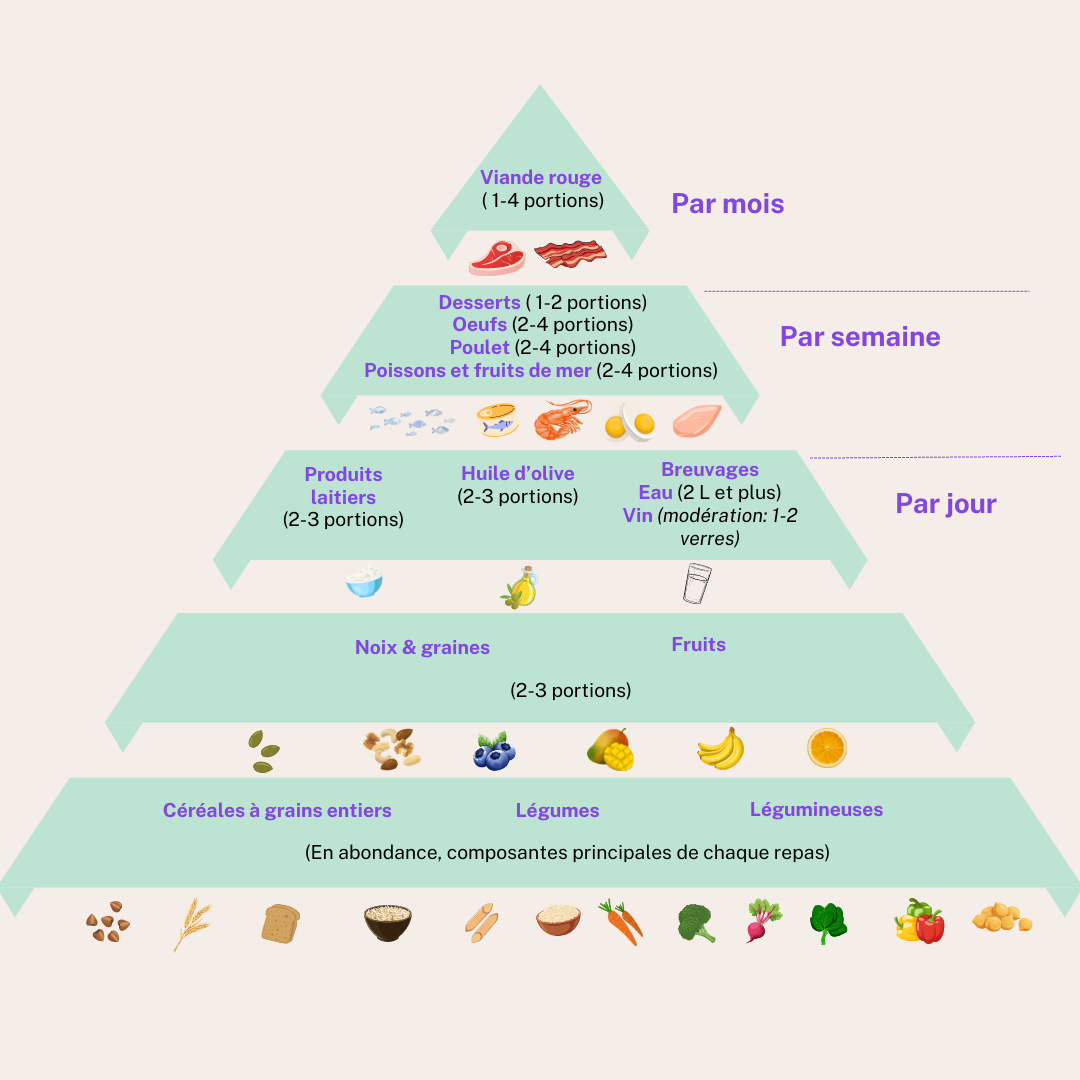
Pyramid adapted from Plaz Torres et al. (2019) (15)
In short, for skin health (8):
- Focus on vegetables and fruit every day;
- Choose whole grains: whole oats, buckwheat, millet, sweet potatoes, whole wheat, quinoa, barley, legumes, wild and brown rice;
- Aim for daily consumption of nuts and seeds;
- Favour plant proteins (legumes, tofu, tempeh, textured vegetable proteins (TVP));
- Aim to eat omega-3-rich fish (salmon, tuna, trout, sardines, mackerel, herring) 2-3 times a week;
- Reduce consumption of red and processed meats and foods rich in added sugars and high GIs.

References
(1) American Skin Association (ASA) 2020 Healthy Skin https://www.americanskin.org/about/
(2) Association of UK Dietitians 2019 Skin health: Food Fact Sheet https://www.bda.uk.com/resource/skin-health.html
(3) De Pessemier et al. (2021) Gut-Skin Axis: Current Knowledge of the Interrelationship between Microbial Dysbiosis and Skin Conditions. Microorganisms Feb 11;9(2):353. https://www.ncbi.nlm.nih.gov/pmc/articles/PMC7916842/
(4) Easton Dermatology Associates 2023 Nutrition and Your Skin Health https://www.eastondermatology.com/blog/nutrition-and-your-skin-health
(5) Garbicz et al. (2021) Nutritional Therapy in Persons Suffering from Psoriasis. Nutrients Dec 28;14( 1 ):119. https://pubmed.ncbi.nlm.nih.gov/35010995/
(6) Juhl et al (2018) Dairy Intake and Acne Vulgaris: A Systematic Review and Meta-Analysis of 78,529 Children, Adolescents, and Young Adults. Nutrients Aug 9;10( 8 ):1049. https://pubmed.ncbi.nlm.nih.gov/30096883/
(7) Kapoor et al. (2022) Psoriasis: Interplay between dysbiosis and host immune system. Autoimmun Rev Nov;21(11):103169. https://pubmed.ncbi.nlm.nih.gov/35964945/
(8) Katta and Desai (2014) Diet and dermatology: the role of dietary intervention in skin disease. J Clin Aesthet Dermatol Jul;7( 7 ):46-51. https://pubmed.ncbi.nlm.nih.gov/25053983/
(9) Lee et al (2023) Vegan Diet in Dermatology: A Review. J Clin Med Sep 6;12(18):5800. https://www.mdpi.com/2077-0383/12/18/5800#:~:text=In%20conclusion%2C%20although%20there%20are,disease%20and%20its%20associated%20comorbidities.
(10) Maciel-Fiuza et al (2023) Role of gut microbiota in infectious and inflammatory diseases. Front Microbiol Mar 27;14:1098386. https://pubmed.ncbi.nlm.nih.gov/37051522/#:~:text=Thousands%20of%20microorganisms%20compose%20the,inflammation%20in%20different%20immunological%20contexts.
(11) Mahmud et al. (2022) Impact of gut microbiome on skin health: gut-skin axis observed through the lenses of therapeutics and skin diseases. Gut Microbes Jan-Dec;14( 1 ):2096995. https://www.ncbi.nlm.nih.gov/pmc/articles/PMC9311318/
(12) Meixiong et al (2022) Diet and acne: A systematic review. JAAD Int Mar 29;7:95-112. https://pubmed.ncbi.nlm.nih.gov/35373155/
(13) Musumeci et al. (2022) The role of lifestyle and nutrition in psoriasis: Current status of knowledge and interventions. Dermatol Ther Sep;35( 9 ):e15685. https://pubmed.ncbi.nlm.nih.gov/35790061/
(14) O'Neill et al. (2016) The gut-skin axis in health and disease: A paradigm with therapeutic implications. Bioessays Nov;38(11):1167-1176. https://pubmed.ncbi.nlm.nih.gov/27554239/
(15) Plaz Torres et al. (2019) Mediterranean Diet and NAFLD: What We Know and Questions That Still Need to Be Answered. Nutrients Dec 5;11(12):2971. https://pubmed.ncbi.nlm.nih.gov/31817398/
(16) Sardana and Sachdeva (2022) Role of nutritional supplements in selected dermatological disorders: A review. J Cosmet Dermatol Jan;21( 1 ):85-98. https://pubmed.ncbi.nlm.nih.gov/34564936/
(17) Schagen et al. (2012) Discovering the link between nutrition and skin aging. Dermatoendocrinol. Jul 1;4( 3 ):298-307. https://www.ncbi.nlm.nih.gov/pmc/articles/PMC3583891/
(18) Stec et al (2023) Bacterial Metabolites: A Link between Gut Microbiota and Dermatological Diseases. Int J Mol Sci Feb 9;24( 4 ):3494. https://pubmed.ncbi.nlm.nih.gov/36834904/
(19) Widhiati et al (2021) The role of gut microbiome in inflammatory skin disorders: A systematic review. Dermatol Reports Dec 28;14( 1 ):9188. https://pubmed.ncbi.nlm.nih.gov/35371420/
 French
  English